
Industrial & OT networks
Fiber links in environments where copper isn't an option, temperature, EMI, ground loops, distance.
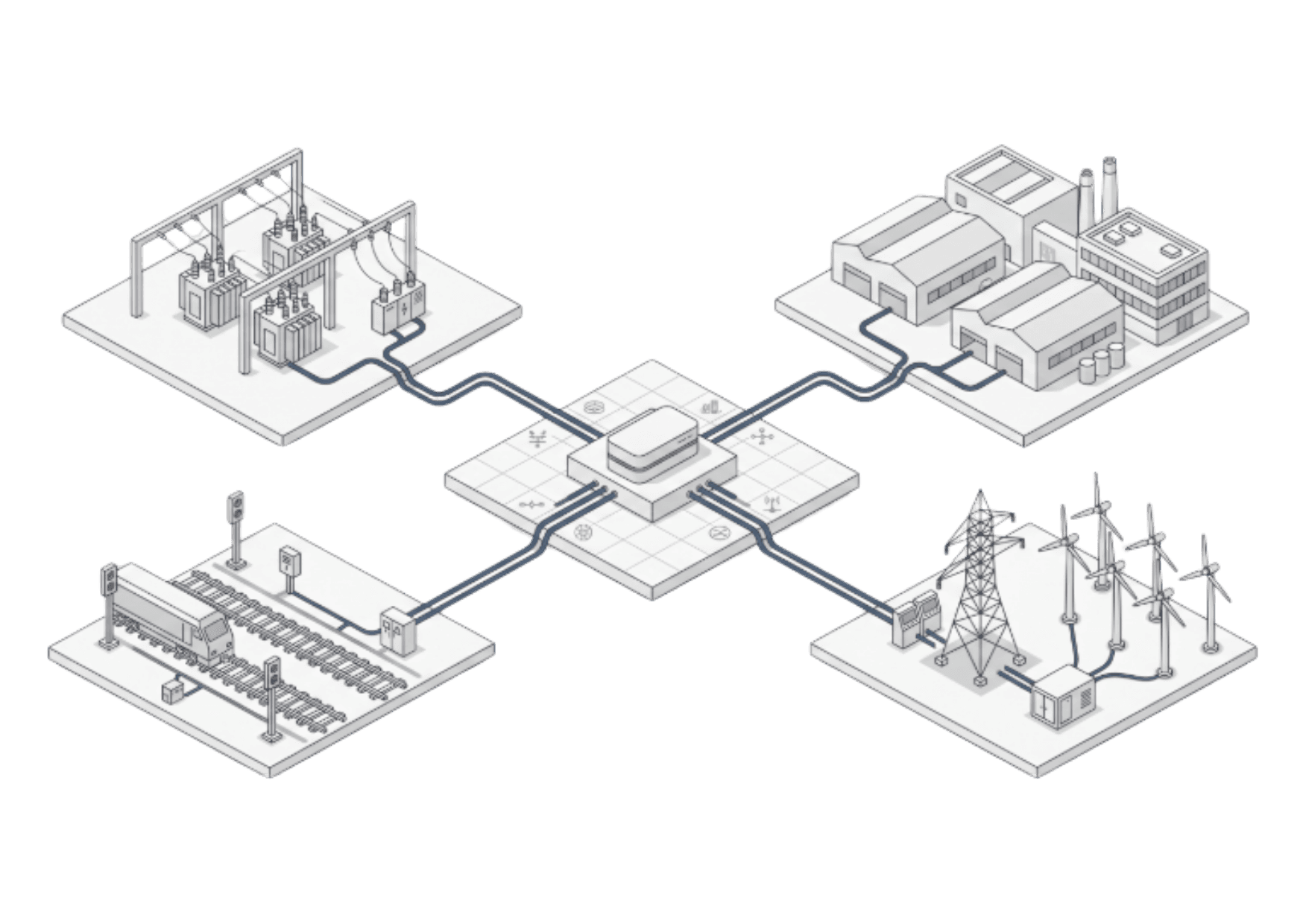
Industrial networks operate in environments that retail-grade switching gear was never designed for. Substations, manufacturing floors, oil and gas refineries, mining operations, rail trackside cabinets, water-treatment plants, all share the same set of constraints. Wide temperature swings (−40 to +85 °C), electromagnetic interference from heavy machinery, ground-potential differences across long runs, and physical environments that destroy copper Ethernet. Fiber is the answer, and industrial-grade optical transceivers are the enabling component.
Operating constraints
- Temperature extremes: −40 °C in unconditioned cabinets, +85 °C in equipment rooms behind production lines
- EMI from motors, VFDs, welding equipment, and HV switchgear
- Ground-potential differences across kilometre-scale runs
- MTBF requirements measured in years, not months
- Hazardous-area (ATEX / IECEx) restrictions in process industries
Use cases
Substation automation (IEC 61850)
Process-bus and station-bus traffic between IEDs, RTUs, and SCADA. Typically 100 Mb or 1G fiber with industrial-temperature SFPs over single-mode for inter-substation links and multi-mode within the control building. Determinism and EMI immunity are the drivers.
Factory floor backbones
Aggregating PROFINET, EtherNet/IP, and EtherCAT cell traffic to plant-level MES and historian systems. 1G fiber uplinks between line-side managed switches and IDF, with industrial-temp SFPs in unconditioned cabinets.
Trackside and tunnel networks
Rail signalling backhaul, tunnel CCTV, and station-to-OCC links. Long single-mode runs (often 20–80 km between stations) using BiDi or DWDM SFPs to maximise fibre-pair utilisation.
Energy generation and grid
Wind-farm SCADA aggregation, solar-farm DC-to-AC inverter telemetry, transmission protection signalling. Multi-mode for within-substation runs, single-mode LR/ER for inter-site links across the right-of-way.
Recommended SKUs for this segment
- NAP-SFP-LX-IND (1000BASE-LX, −40 to +85 °C)
- NAP-SFPP-LR-IND (10GBASE-LR, industrial-temp)
- NAP-SFP-BX-D / BX-U (1G BiDi for single-strand fibre)
- NAP-SFP-CWDM (8-channel CWDM for 80 km dark fibre)
Design notes
- Specify the industrial-grade temperature variant on every SKU, commercial-grade modules will throttle or fail in unconditioned cabinets.
- BiDi pairs are common in rail and utility deployments to halve fibre-pair count.
- Verify hazardous-area certification (ATEX / IECEx) where required; standard transceivers are not certified for Zone 1 / 2 enclosures.
Designing a industrial & ot networks deployment?
Our pre-sales engineers will review your topology, fibre plant, and switch firmware and spec the SKU list before you order. Free.